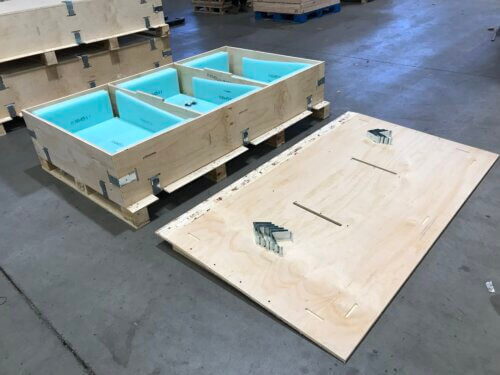
Case Study: Securing Heavy Aerospace Ground Support Equipment with MIL-SPEC ASTM D6256 Skidded Crates
Transporting heavy, high-value aerospace equipment requires more than standard shipping crates, especially when military specifications, complex weight distribution and harsh environmental conditions are involved. For defense contractors, even minor packaging failures can lead to costly equipment damage, shipment delays and compliance issues.
When a Tier-1 defense aerospace contractor needed to transport 2,200-pound ground support equipment (GSE) to an overseas naval air station, Basin Industries developed a custom MIL-SPEC wood crating solution engineered for structural stability, corrosion protection and long-term storage.
This case study explores how precision-engineered ASTM D6256 skidded crates and MIL-PRF-131 vapor barriers helped protect critical aerospace equipment throughout its journey.
The Challenge: Heavy Asymmetrical Loads with Harsh Coastal Storage
A major defense aerospace contractor was tasked with deploying critical Ground Support Equipment (GSE)—including heavy fluid-test consoles and electromechanical actuators—to an overseas naval air station. The logistics presented three major hurdles:
- Extreme Weight & Asymmetrical CG: Weighing in at 2,200 lbs with an uneven center of gravity (CG), the equipment exceeded the safe load capacities of standard commercial crating. Previous attempts using basic pallets resulted in severe base deflection and dangerous tipping hazards during forklift transit on the tarmac.
- Corrosion Risk in Long-Term Storage: The destination subjected the equipment to harsh, salt-laden coastal air. Furthermore, the units were expected to sit in unconditioned storage for up to eight months prior to deployment.
- Strict Defense Contract Compliance: The prime contract explicitly mandated that all packaging must meet rigorous Department of Defense (DoD) specifications. The shipment would be subjected to strict Defense Contract Management Agency (DCMA) inspection; any deviation from MIL-SPEC packaging standards would result in rejected shipments and costly timeline delays.
The contractor turned to Basin Industries to design a compliant, heavy-duty wood packaging solution that could simultaneously bear the load and defeat the elements.
The Solution: Precision-Engineered MIL-SPEC Wood Packaging
Basin Industries’ engineering team evaluated the weight, dimensions, and environmental threats to develop a comprehensive MIL-SPEC crating system utilizing its specialized wood manufacturing capabilities.
- Heavy-Duty Structural Integrity (ASTM D6256 / MIL-B-26195(C)): To safely support the 2,200 lb asymmetrical payload, Basin designed and manufactured custom Cleated Wood Shipping Boxes with a Skidded Load-Bearing Base in strict accordance with ASTM D6256. Because this standard is specifically engineered to handle concentrated loads up to 2,500 pounds, the heavy 4×4 skidded base prevented base-sag and allowed for stable, 4-way forklift handling. Basin engineers integrated custom internal wood blocking and bracing components to secure the equipment’s center of gravity and prevent shifting during ocean and air transit.
- Military-Grade Vapor Barrier Protection (MIL-PRF-131 & MIL-DTL-117H): Wood crating provides structural defense, but to protect the unpainted machined surfaces and sensitive electronics from salt fog and humidity, Basin implemented a hermetic barrier system. The GSE was sealed inside heavy-duty foil vapor barrier bags utilizing MIL-PRF-131 material. The bags themselves were converted and heat-sealed following the precise MIL-DTL-117H packaging method. Before final vacuum sealing, calculated desiccant packs were strategically placed inside the barrier to maintain a safe, low relative humidity (RH) throughout the equipment’s 8-month storage life.
- Accessory and Component Protection (ASTM D5118): The GSE test consoles required the shipment of auxiliary cables, sensors, and modular components. Instead of leaving them loose inside the main crate, Basin provided heavy-duty corrugated fiberboard boxes compliant with ASTM D5118 (PPP-B-636). These were securely nested within the main ASTM D6256 wood crate, ensuring organized, military-grade protection for all sub-components.
The Results: Flawless DCMA Inspection and Safe Deployment
By partnering with Basin Industries, the aerospace contractor transformed a logistical liability into a flawlessly executed deployment.
- Passed DCMA Inspection on the First Pass: Because Basin Industries properly certified and constructed the crates to exact ASTM and MIL-SPEC standards, the packaging documentation and physical crates passed strict defense compliance checks without a single discrepancy.
- Zero Deflection or Handling Incidents: The ASTM D6256 skidded load-bearing base easily supported the 2,200 lb load, completely eliminating the deflection and forklift instability issues the contractor had previously experienced.
- 100% Corrosion-Free Arrival: When the crates were finally opened at the coastal naval air station eight months later, the MIL-PRF-131 foil barriers had done their job. The GSE test consoles were perfectly preserved, completely free of rust, pitting, or moisture damage, and ready for immediate deployment.
Need help with a challenging Mil-Spec crating requirement? We can help!
More Information
continue reading