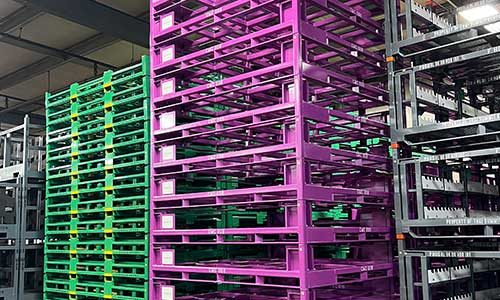
Steel, aluminum, wood, plastic or corrugated: How to choose the right industrial packaging material
Choosing industrial packaging is not simply a matter of deciding whether to use a rack, crate, pallet or container. The material itself can have a major impact on product protection, handling, freight efficiency, reusability, lifecycle cost and the way packaging fits into a manufacturing or distribution process.
Steel, aluminum, wood, plastic and corrugated packaging each have advantages. The right choice depends on what is being moved, how often the packaging will be used, the environment it will encounter and what the customer needs the packaging to accomplish.
That decision has become even more important as manufacturers continue to manage changing material costs and supply conditions. In September 2026, the Institute for Supply Management reported higher prices across a wide range of manufacturing inputs, including steel, aluminum, corrugated products, plastic-based products and packaging materials. Steel and aluminum products were also among the commodities manufacturers identified as being in short supply.
When costs and availability are changing, industrial packaging should not be selected simply because a particular material has always been used. It should be engineered around the application.
That is one of the advantages of working with Basin Industries. Our capabilities span steel, aluminum, wood, plastic and corrugated cardboard, allowing our team to approach packaging challenges from the perspective of the product being protected and the process it needs to support.
Start with the application, not the material
Before choosing a packaging material, it helps to answer a few basic questions:
- How heavy is the product?
- Is it fragile or susceptible to surface damage?
- How many times will the packaging be used?
- Will it travel in a closed-loop system or be shipped once to a customer?
- Does it need to be handled by forklift, crane or automation equipment?
- Will it be stored outdoors?
- Does the empty packaging need to collapse or stack efficiently for return transportation?
The answers can significantly change the economics of the packaging system.
A lightweight product shipped once may not justify the cost or weight of a steel rack. Conversely, a high-value component moving repeatedly between plants may quickly make a disposable packaging system expensive.
The objective should be to find the material and design that provide the required protection and handling performance at an appropriate total cost over the life of the program.
When steel packaging makes sense
Steel is often an excellent choice for demanding returnable applications.
Custom steel racks, containers and pallets can be designed to support heavy loads, protect complex components and withstand repeated industrial handling. Steel also provides considerable flexibility for incorporating locating features, dunnage, stacking structures, forklift access and other application-specific requirements.
For closed-loop automotive and industrial programs in particular, a well-designed steel rack can remain in circulation for repeated trips rather than requiring new packaging for every shipment.
Steel can be a strong choice when the application requires:
- High load capacity
- Repeated reuse
- Resistance to demanding industrial environments
- Precise part positioning
- Stacking or racking
- Repairability
- Integration with manufacturing and material-handling processes
The initial investment may be higher than some expendable alternatives, which is why steel packaging should be evaluated based on cost per trip and expected service life, not purchase price alone.
Where aluminum packaging offers advantages
Aluminum can provide many of the benefits associated with fabricated metal packaging while reducing overall weight.
That can be particularly valuable when packaging must be moved frequently, when weight contributes materially to transportation or handling requirements, or when corrosion resistance is important.
Custom aluminum racks and containers can also be fabricated for specialized industrial applications where strength is required but minimizing tare weight is valuable.
The tradeoff is that aluminum typically has different material costs, strength characteristics and repair considerations than steel. Whether those differences make aluminum the better choice depends on the application rather than on a universal rule.
Basin Industries works with both steel and aluminum, allowing material selection to be based on the customer’s operational requirements rather than the limitations of a single fabrication process.
When engineered wood packaging is the right solution
Wood remains one of the most versatile materials used in industrial packaging.
Custom crates, skids and pallets can be built around products of unusual size or shape, making wood particularly useful for heavy machinery, industrial equipment, low-volume shipments and products that require substantial structural support without the economics of a permanent fabricated metal system.
Wood packaging can also be easier to modify for changing dimensions or one-off projects.
For companies shipping internationally, however, wood packaging may need to meet phytosanitary requirements such as ISPM 15. Those requirements should be considered during packaging planning rather than shortly before shipment.
Wood can be particularly effective when:
- Volumes are relatively low
- Products are large or irregular
- Packaging does not need to complete hundreds of return trips
- Custom blocking and bracing are required
- Heavy-duty shipping solution is needed without investing in permanent metal packaging
The role of plastic in reusable packaging
Plastic packaging can be a strong solution for applications that benefit from low weight, moisture resistance, cleanliness and repeated use.
Depending on the design, plastic pallets, containers and other packaging components can work well in manufacturing, warehousing and distribution environments where consistent dimensions and easy handling are important.
Plastic may also be useful where wood is undesirable because of moisture, contamination or international shipping considerations.
As with any material, however, plastic needs to be evaluated against the load, handling environment and expected lifecycle of the packaging. A lightweight plastic system designed for one application should not automatically be substituted into a demanding heavy-industrial program.
Basin’s packaging capabilities include custom plastic solutions alongside metal, wood and corrugated products, allowing these tradeoffs to be considered as part of the overall packaging design.
When corrugated packaging is the most efficient option
Corrugated cardboard remains one of the most widely used packaging materials for good reason.
It is lightweight, relatively economical, highly customizable and well suited to a wide range of expendable and limited-use applications. Corrugated packaging can also be combined with inserts, partitions, protective materials and other components to create surprisingly sophisticated packaging systems.
For many products, a custom corrugated solution may be more economical than building a durable returnable container that will never actually return.
Corrugated packaging is often a strong fit when:
- The shipment is one-way
- Product weight is moderate
- Low packaging weight is important
- Volumes are high
- Storage space matters
- Packaging needs to be easily recycled after use
In other cases, corrugated material can be used as part of a hybrid system inside reusable racks or containers.
That illustrates an important point: choosing industrial packaging does not always mean choosing one material.
Hybrid packaging can offer the best answer
Some of the most effective industrial packaging systems combine materials.
A fabricated steel rack may use plastic or foam dunnage to protect finished surfaces. A wood crate may incorporate corrugated partitions. A reusable container may include replaceable components designed to accommodate multiple product variants.
The question is not necessarily whether steel is better than wood, or whether plastic is better than corrugated.
The better question is: What combination of materials provides the best protection, handling efficiency and lifecycle economics for this particular product?
A supplier with expertise across multiple materials is better positioned to answer that question without forcing the application into a predetermined manufacturing capability.
Look beyond the initial purchase price
One of the biggest mistakes in industrial packaging procurement is comparing solutions entirely on their upfront cost.
Packaging economics can include:
- Initial manufacturing cost
- Expected number of trips
- Freight weight and cube utilization
- Product damage
- Labor required for loading and unloading
- Repair and maintenance
- Empty-return transportation
- Storage requirements
- Disposal or recycling costs
- Cost of replacing packaging throughout the program
A more expensive returnable rack may ultimately cost less per shipment if it remains in service for many cycles. Likewise, investing in a durable returnable system may make little financial sense when packaging will only be used once.
Lifecycle analysis helps purchasing, engineering and logistics teams compare alternatives on the basis of total packaging cost, not simply unit price.
Reuse and refurbishment can extend packaging value
Material selection also affects what happens after packaging has completed its initial service cycle.
Basin Industries designs and supports reusable packaging systems and provides refurbishment and recycling services intended to keep packaging in use longer where practical. Its capabilities include returnable metal, wood and plastic packaging as well as inspection, repair and lifecycle management.
That can be particularly important for large packaging fleets.
Replacing every damaged rack or container is not always necessary. Depending on the construction and condition, repair or refurbishment may return packaging to service and extend the value of the original investment.
Considering repairability during the design stage can therefore influence the long-term economics of a packaging program.
Material availability should be part of the conversation
Material prices and availability change.
September’s U.S. manufacturing data provide a good example. Manufacturers reported higher costs for aluminum, steel, plastic-based products, corrugated products and packaging materials, while steel and aluminum products also appeared among materials in short supply.
Those conditions do not mean manufacturers should constantly switch packaging materials based on short-term price movements.
They do mean that companies benefit from having options.
When a packaging provider can work across multiple materials and manufacturing processes, customers can evaluate whether design changes, alternate materials or hybrid solutions might improve availability or economics without compromising the requirements of the application.
One packaging problem, multiple ways to solve it
Basin Industries was created by bringing together complementary packaging and manufacturing businesses under a single organization. The result is a broader set of capabilities spanning steel, aluminum, wood, plastic and corrugated packaging, supported by engineering, manufacturing, quality control and field services.
For customers, that means the conversation can begin with the packaging problem rather than a predetermined material.
- What are you moving?
- How does it need to be protected?
- How often will the packaging be used?
- How will it move through your operation?
- What matters most: weight, durability, returnability, storage, cost, repairability or some combination of those factors?
Those answers should drive the design.
Whether the best solution is fabricated steel, lightweight aluminum, engineered wood, reusable plastic, corrugated cardboard or a combination of materials, the objective remains the same: protect the product, support efficient handling and deliver the best long-term value for the application.
To discuss a custom industrial packaging challenge, contact Basin Industries and let our engineering and manufacturing teams help identify the right solution.
continue reading