
QUALITY CONTROL

Basin Business System

Certified quality management

The Basin Business System is our ISO 9001:2015-certified quality management system (QMS) developed in partnership with third-party lean operations experts.

A man guides a large piece of timber across an industrial planer.

Implementation

The Basin Business System (BBS) embodies a holistic management approach focused on continuous improvement and operational excellence. It emphasizes being present, respecting, and learning from employee insights. BBS strategically targets waste reduction through value stream analysis, daily improvement efforts and Kaizen events. It implements fundamental principles like Takt Time, one-piece flow and pull systems while ensuring workplace organization and accountability through 5S methodology and visual controls. BBS sets clear targets across safety, quality, delivery, productivity, margin and working capital, driving the organization towards sustained improvement and success.

Working to takt time for reliable delivery

Takt Time (available production time divided by customer demand) sets the rhythm for each cell. We design capacity, staffing, and buffer strategy around that “heartbeat” to enable one-piece flow. This curbs overproduction, stabilizes queues, and helps us promise realistic, repeatable lead times.

With MoffittXL’s guidance, we align routings and resource plans to Takt, implement point-of-use kanban, and reduce changeover pain (SMED) so smaller batches still make business sense. This lowers WIP and increases on-time performance.
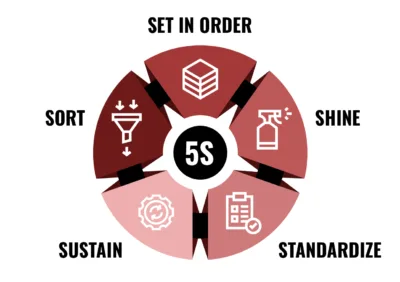
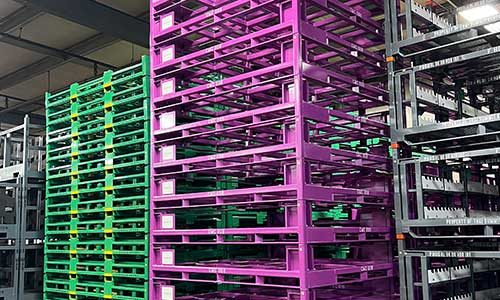
What 5S Methodology looks like

5S is more than tidiness; it’s the daily discipline that stabilizes processes and reveals problems early. The five pillars of the 5S methodology are: Sort, Set in order, Shine, Standardize, Sustain.

The 5 Esses: Sort, Set in Order, Shine, Standardize, Sustain

When we sort through everything in our shop, we remove nonessential tools, fixtures and materials from cells. Red-tagging and disposition routines keep benches, carts, and crib locations limited to what the job actually requires, which cuts down search time, prevents mix-ups and improves safety.

Everything should have a defined “home”. Tool shadow boards, labeled gauge drawers, point-of-use consumables, and first-in-first-out (FIFO) lanes for incoming stock and work in progress are examples of tactics that we use to order the madness that can be found in a busy machine shop. Visual cues like floor markings are key; they provide clear instruction that transcends written language and makes any abnormality obvious instantly.

Keeping things clean serves many purposes. Routine wipe-downs, chip-load checks and coolant condition audits double as inspection steps that catch wear or drift before they become quality escapes. Dirt and grime can also clog up machinery and hide potential safety issues. When everything is kept clean, you know exactly what you’re working with.

We codify best practices and standard work into clear visuals like setup sheets, torque specs, probe routines, offsets, gauge R&R references, and changeover checklists so the “right way” is the easy way on every shift. Checklists and standard procedures also ensure nothing is forgotten or skipped—there’s a reason airline pilots stick to checklists before flight, and it’s no different in our shop.

Perhaps the toughest step in the 5S cycle… To sustain is to carry forth all the hard work of the previous four steps indefinitely. Just as our mothers told us when we were young, we put things back after we use them and clean up after ourselves. This way, 5S is accomplished little by little every day instead of in the form of a major, time-consuming project.

RELATED

Products and Services